
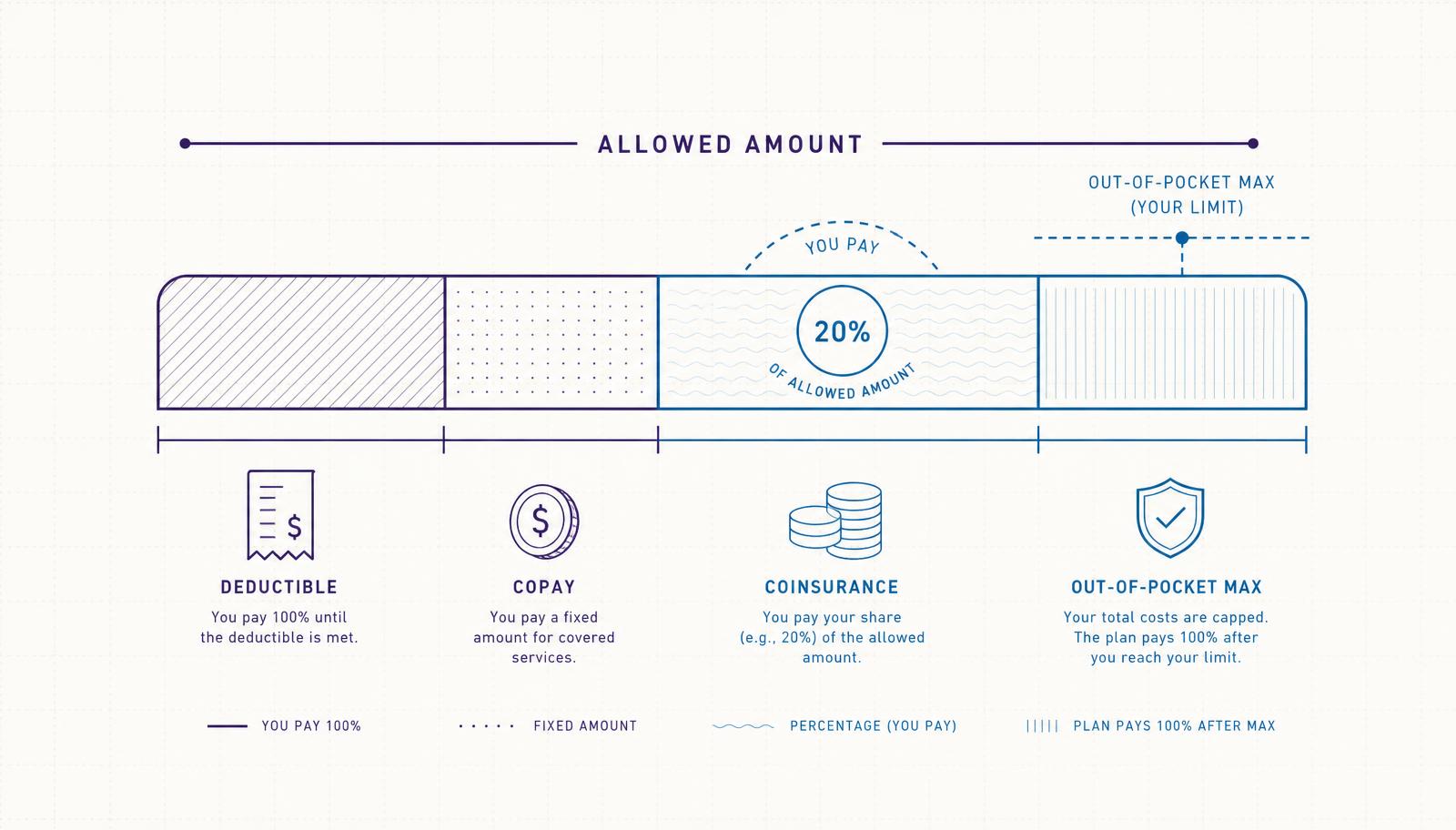
Deductible, Copay, Coinsurance, and Out-of-Pocket Max: What You Actually Pay
Deductibles, copays, coinsurance, and out-of-pocket maximums all affect what you pay for healthcare, but none tells the whole story alone. Here is how these pieces work together with the negotiated or allowed price of your care.
By The Maggy Health Team
Health insurance has its own language.
Deductible.
Copay.
Coinsurance.
Out-of-pocket maximum.
Most people have heard these terms.
Far fewer could look at a $1,500 medical service and confidently explain what they will actually owe.
And that is understandable.
Because your health insurance card might say:
- Deductible: $2,500
- Primary Care: $30
- Specialist: $60
- Coinsurance: 20%
- Out-of-Pocket Max: $7,500
But none of those numbers, by themselves, necessarily answer the question you actually care about:
How much will this healthcare service cost me?
Let's break it down.
Start With the Price Your Plan Recognizes
Before we even get to your deductible, copay, or coinsurance, there is another number that matters: the allowed amount.
If an in-network provider bills $1,000 for a service, your insurance company may have negotiated an allowed amount of $600.
For purposes of your benefit, that $600 may be the more important number.
You generally are not simply applying your deductible or coinsurance to whatever amount appears on the provider's original bill.
You are applying your benefits to the amount recognized under your health plan's rules.
So already we have two numbers:
- Provider's billed charge: $1,000
- Health plan's allowed amount: $600
Now we have to figure out how you and your insurance company divide that $600.
That is where cost-sharing comes in.
What Is a Deductible?
Your deductible is the amount you may have to pay toward covered healthcare services before your health plan begins paying for services that are subject to the deductible.
Suppose your plan has a $2,000 annual deductible and you have paid $0 toward it this year.
You receive an in-network healthcare service with an allowed amount of $500.
If that service is fully subject to your deductible, you may owe the $500 allowed amount.
Now you have $1,500 remaining on your deductible.
Later, you receive another covered service with an allowed amount of $1,500.
If it is also subject to the deductible, you may pay that amount and reach your $2,000 deductible.
But here's where people often get confused:
Having a $2,000 deductible does not necessarily mean you pay the first $2,000 of every kind of healthcare yourself.
Plans can work differently.
- Some services may have copays before the deductible is met.
- Certain qualifying preventive services may be covered without cost-sharing.
- Prescription drugs may have different rules or even a separate deductible.
- Family plans may have individual and family deductibles.
So your deductible is important.
But it is not the entire story.
What Is a Copay?
A copayment, or copay, is generally a fixed dollar amount associated with a covered service.
For example:
- Primary care visit: $30 copay
- Specialist visit: $60 copay
- Urgent care: $75 copay
That sounds straightforward.
If you see your primary care doctor, you pay $30.
Sometimes, yes.
But you still need to understand how your particular plan works.
- Does the copay apply before the deductible?
- Only after the deductible?
- Does it cover the entire visit?
- What if additional testing is performed?
- What if laboratory work, imaging, or another service is billed separately?
A $30 office-visit copay does not necessarily mean:
Everything that happens at this appointment costs me $30.
It may mean that the office-visit portion of the encounter has a $30 copay while other services are handled differently.
What Is Coinsurance?
Coinsurance is different from a copay because it is usually a percentage rather than a fixed dollar amount.
Suppose your plan says 20% coinsurance after deductible, and you have already met your deductible.
You receive a covered in-network service with an allowed amount of $1,000.
If 20% coinsurance applies:
- You pay $200.
- Your health plan pays $800.
Simple enough.
But notice something important.
To calculate your coinsurance, you first needed to know the allowed amount.
Twenty percent of $500 is very different from 20% of $2,000.
That means the negotiated price of the healthcare service can directly affect what comes out of your pocket.
This Is Why Price Shopping Can Matter Even When You Have Insurance
Imagine you have already met your deductible and owe 20% coinsurance.
Two appropriate in-network imaging centers can provide the same planned service.
Your health plan's negotiated amounts are:
- Facility A: $600
- Facility B: $1,500
With 20% coinsurance:
- Your share at Facility A: $120
- Your share at Facility B: $300
Same insurance.
Same 20% coinsurance.
Both in-network.
Very different potential cost.
This is one reason understanding healthcare pricing can still matter even after someone has insurance.
Your benefit determines how the cost is divided.
The negotiated rate helps determine what amount is being divided.
What Is the Out-of-Pocket Maximum?
The out-of-pocket maximum is one of the most important financial protections in health insurance.
It is generally the most you will have to pay during the plan year for your share of covered, qualifying healthcare services under the applicable plan rules.
Amounts that commonly count toward it can include:
- Deductible payments
- Copays
- Coinsurance
Once you reach the applicable out-of-pocket maximum, the health plan generally pays 100% of the allowed amount for covered benefits subject to that protection for the remainder of the plan year.
But the name can be misleading.
"Out-of-pocket maximum" does not necessarily mean the maximum amount of money healthcare can cost you that year.
There are expenses that may not count toward it.
What Usually Doesn't Count Toward Your Out-of-Pocket Maximum?
Depending on your plan and situation, costs outside the protected limit can include things such as:
- Your monthly insurance premiums. The money you pay simply to have the health insurance policy generally does not count toward the out-of-pocket maximum.
- Services your plan doesn't cover. If you choose something excluded from your coverage, that spending may not count.
- Certain out-of-network expenses. Out-of-network care can operate under different rules and may not receive the same protection.
- Amounts above the plan's allowed amount in circumstances where balance billing is permitted. Those amounts may not count either.
This is why seeing "Out-of-pocket maximum: $7,500" doesn't necessarily mean:
No matter what happens, I cannot spend more than $7,500 on healthcare this year.
The details matter.
Let's Put It All Together
Imagine a simplified health plan with:
- Annual deductible: $2,000
- Coinsurance: 20% after deductible
- Out-of-pocket maximum: $6,000
You have not used any healthcare yet this year.
Then you need a planned procedure.
The in-network provider's allowed amount is $5,000.
For this simplified example, assume the entire service is covered and subject to the deductible and coinsurance.
Step 1: Deductible
You pay the first $2,000.
Your deductible is now met.
Remaining allowed amount: $3,000.
Step 2: Coinsurance
Your coinsurance is 20%.
Twenty percent of the remaining $3,000 is $600.
So your total responsibility for this simplified example would be: $2,000 deductible + $600 coinsurance = $2,600.
Your health plan would pay the remaining covered amount under the plan's terms.
And your $2,600 would generally move you closer to your applicable out-of-pocket maximum.
Now compare that with simply knowing "My deductible is $2,000."
The deductible alone did not tell you what you would pay.
Now Change the Provider
Let's make one change.
A second appropriate in-network provider has negotiated an allowed amount of $10,000.
Same procedure. Same insurance. Same deductible. Same coinsurance.
If you still have the full $2,000 deductible remaining, you pay $2,000 toward the deductible.
Then 20% of the remaining $8,000: $1,600.
Total: $3,600.
Compare that with the first example:
- Provider A: $2,600
- Provider B: $3,600
Your insurance benefits did not change.
The underlying negotiated price did.
That is why healthcare decisions increasingly require both benefit information and pricing information.
One without the other tells only part of the story.
And Real Life Can Be More Complicated
The examples above are deliberately simple.
Actual health plans can include:
- Different deductibles for different services
- Individual and family deductibles
- Different copays by provider type
- Different coinsurance by service
- Prescription drug tiers
- Separate pharmacy deductibles
- In-network and out-of-network benefits
- Preferred networks
- Prior authorization requirements
- Services covered before the deductible
- Services excluded from the deductible
- Different rules for preventive care
And healthcare episodes themselves can involve multiple bills.
An outpatient procedure might involve separate claims from:
- The facility
- The physician
- Anesthesiology
- Pathology
- Radiology
- Laboratory services
So answering "What am I going to pay?" can require understanding both sides of the equation: what healthcare costs, and how your benefits apply to that cost.
Your Explanation of Benefits Can Help
After care is processed by your health plan, you may receive an Explanation of Benefits, commonly called an EOB.
It is not necessarily a bill.
It generally helps explain things such as:
- What the provider charged
- The amount recognized or allowed by the plan
- What the health plan paid
- What was applied to your deductible
- Your copay or coinsurance
- The amount you may owe
Learning to read an EOB can make healthcare costs much easier to understand.
But there is an obvious limitation:
The EOB usually helps explain the financial result after the healthcare service has already happened.
Consumers increasingly need better help before they make the decision.
Four Numbers Worth Knowing
Before receiving planned healthcare, it is worth knowing:
1. Your remaining deductible
Not merely the deductible printed on your plan documents.
How much of it do you actually have left this year?
2. Your copay or coinsurance for the service
How does your specific benefit treat the care you are considering?
3. Your remaining out-of-pocket maximum
How close are you to the point where your health plan takes on substantially more of the cost of covered care?
4. The allowed or negotiated price
What price has your health plan established for this service at the provider or facility you are considering?
Together, these numbers can tell a much more useful story.
Why This Matters When Choosing a Health Plan Too
These concepts matter not only when receiving healthcare.
They matter when choosing insurance.
A lower monthly premium can be attractive.
But that plan may have a higher deductible or greater cost-sharing when you actually use care.
Another plan might cost more each month but provide richer benefits for the healthcare services you expect to use.
Neither plan is automatically better.
The right tradeoff depends on the individual.
Someone who uses almost no healthcare may make a different decision from someone who sees several specialists, takes expensive medications, or expects a procedure during the coming year.
This is why comparing health plans solely by premium can be misleading.
Premium is what you pay to have the coverage.
Cost-sharing helps determine what you pay when you use it.
Both matter.
Healthcare Should Calculate More of This for You
Consumers should understand the basic concepts behind their insurance.
But they should not have to perform a miniature actuarial analysis every time they need healthcare.
Imagine instead telling a healthcare guide:
My doctor ordered an MRI. What will it cost?
A useful system should be able to work through the relevant questions:
- Which health plan do you have?
- Which facilities are appropriate?
- Which participate in your network?
- What has your plan negotiated with them?
- How much deductible do you have remaining?
- What coinsurance applies?
- How complete is the pricing information?
- What can we responsibly tell you before you schedule?
That is much closer to the experience we are building toward with Maggy Health™.
Because showing someone their deductible is useful.
Showing them a healthcare price is useful.
But helping them understand what those two things mean together is considerably more useful.
The Takeaway
You do not need to become an insurance expert.
But four concepts can dramatically improve your understanding of healthcare costs:
- Deductible: what you may need to pay before your plan begins sharing the cost of services subject to it.
- Copay: a fixed amount you may pay for a covered service.
- Coinsurance: the percentage of the applicable allowed cost you may pay.
- Out-of-pocket maximum: the applicable limit on how much qualifying cost-sharing you pay for covered care during the plan year.
And underneath all of them is another important number:
The price your health plan recognizes for the healthcare service.
Healthcare costs become easier to understand when we stop looking at these numbers individually and start connecting them.
Because the question consumers actually want answered isn't "What's my deductible?"
What is this care going to cost me?
And healthcare should be much better at answering it.