
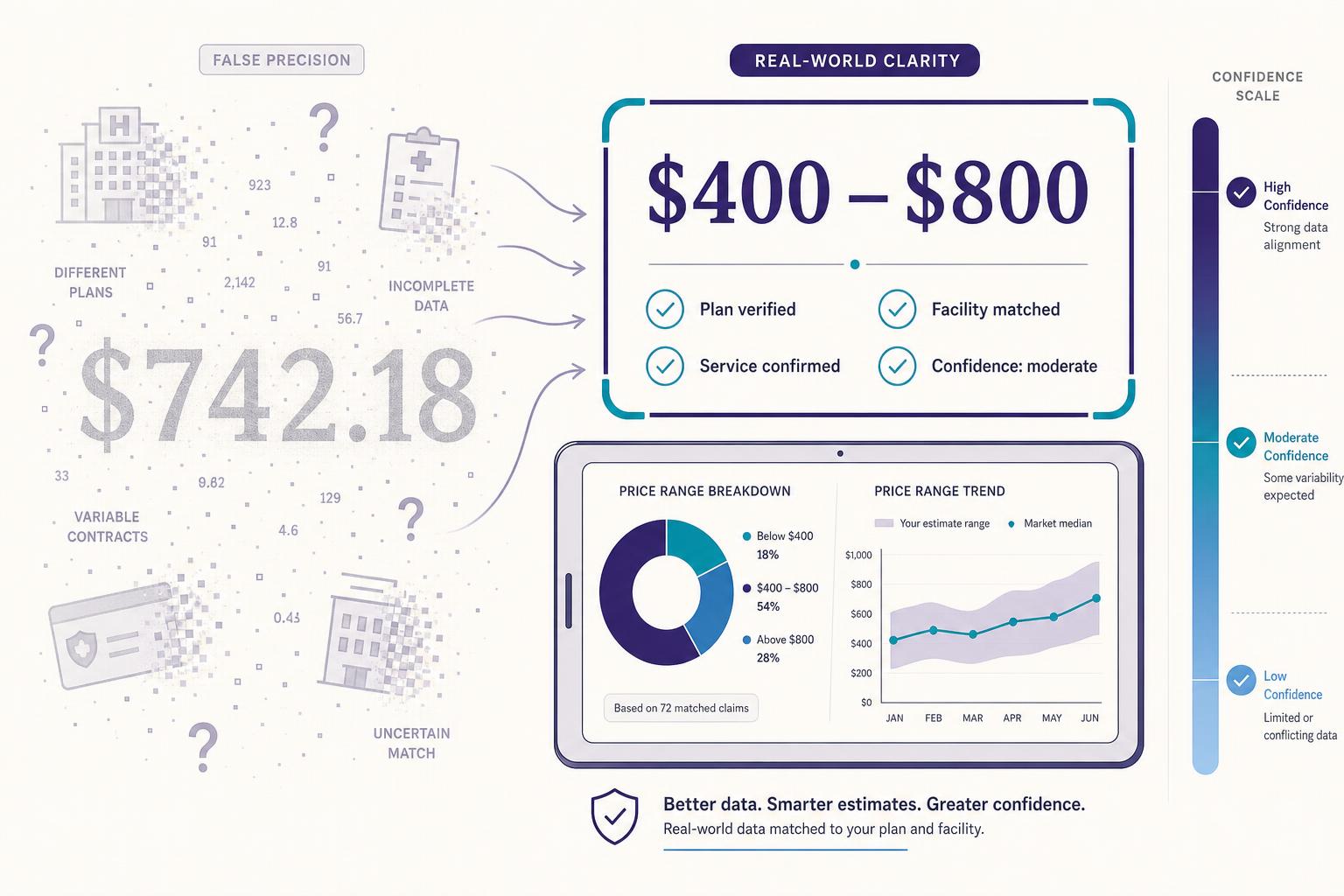
Why We Won't Show You a Healthcare Price We Can't Defend
More healthcare pricing data is becoming available, but finding a number is not the same as finding the right number. Here is why Maggy Health is built to show the strongest truthful pricing information the evidence can support, rather than false precision.
By The Maggy Health Team
Imagine you need an MRI.
You search online and find this:
Estimated price: $742.18
That looks pretty convincing.
It is specific. It has dollars and cents. It came from healthcare pricing data.
But what exactly does $742.18 represent?
- Is it the negotiated price for your health plan?
- Does it apply to the facility where you are going?
- Does it include the radiologist who interprets the image?
- Does it include both the technical and professional components?
- Is contrast included?
- Is it the right billing code?
- Does your deductible apply?
And perhaps most importantly:
Is $742.18 actually the number you need in order to make the decision in front of you?
If we cannot answer those questions, displaying a very precise number may create something worse than uncertainty.
It can create false certainty.
At Maggy Health, we think healthcare price transparency needs a different standard.
We should only show a healthcare price when we can explain what it represents and defend why it belongs in the decision.
Healthcare Has More Pricing Data Than Ever
For years, one of the biggest problems in healthcare was that consumers had almost no visibility into prices.
That is changing.
- Hospitals publish substantial amounts of pricing information.
- Health insurers publish negotiated-rate data.
- Medicare publishes extensive payment information.
- Additional public datasets can help establish benchmarks and comparisons.
- Cash prices may also be available directly from healthcare providers.
The amount of accessible healthcare pricing data has grown enormously.
That is progress.
But it introduces a new problem.
Finding a number is becoming easier. Determining whether it is the right number is still hard.
A Price Can Be Accurate and Still Be Misleading
This distinction is extremely important.
Suppose we correctly identify a negotiated rate of $500 for a healthcare service.
The number itself may be completely accurate.
But imagine that $500 represents only one component of the care.
The patient may also receive:
- A separate physician charge
- A facility charge
- Anesthesia
- Pathology
- Laboratory services
- Imaging interpretation
- Other services associated with the episode
The $500 price was not wrong.
It was incomplete.
If we present it to a consumer as:
Your procedure costs $500.
we have transformed accurate data into a misleading answer.
That is one of the central challenges of healthcare price transparency.
The Health Plan Has to Match
Another example:
Suppose we find a negotiated rate between a large insurer and a hospital.
You are covered by that insurer.
Can we show you the rate?
Not necessarily.
An insurance company can offer many different products and networks.
A rate associated with one product may not apply to another.
An employer-sponsored plan can have different network or benefit arrangements from an ACA plan bearing the same insurer's name.
A Medicare Advantage product can be different again.
Knowing:
My insurance company is BlueSomething.
is not always enough.
The real question is:
Does this pricing evidence apply to my specific coverage?
If we cannot establish that relationship strongly enough, we should not pretend that we can.
The Provider Has to Match Too
Healthcare organizations are complicated.
One recognizable health system name might represent:
- Multiple hospitals
- Physician groups
- Imaging centers
- Surgery centers
- Laboratories
- Outpatient departments
- Other legal entities and billing organizations
A consumer might reasonably think:
I'm going to Example Health.
The pricing data may require us to know precisely which Example Health location and billing entity is providing the service.
A rate attached to one facility should not casually be presented as the price at another simply because they share a brand.
Again, the problem is not whether we can find a number.
The problem is whether we can establish that the number belongs to the decision.
The Exact Service Matters
Healthcare pricing often depends on billing codes.
But consumers do not think in billing codes.
They think:
- I need an MRI.
- I need a colonoscopy.
- I need blood work.
- I need cataract surgery.
Those descriptions may correspond to multiple codes, different clinical circumstances, different sites of service, and different combinations of professional and facility services.
Even when the code is known, additional context can matter.
That means there is an important distinction between the price of a billing component and the expected cost of the complete healthcare experience.
Consumers deserve to know which one they are looking at.
Then There Is What You Actually Pay
Even if we establish a reliable negotiated price, we may still not know your final out-of-pocket responsibility.
Your personal cost can depend on your benefits.
- Have you met your deductible?
- Do you owe coinsurance?
- Is there a copay?
- Have you reached your out-of-pocket maximum?
- Does the service require authorization?
- Is it considered preventive or diagnostic?
- Are all the people involved in the service participating in the relevant network?
Those questions introduce another distinction:
- Provider price — what the healthcare provider and payer have agreed can be paid.
- Member responsibility — what you may ultimately owe under your benefits.
Those are related.
They are not interchangeable.
A healthcare navigation system should not pretend that knowing one automatically proves the other.
Not Every Healthcare Price Deserves the Same Confidence
This led us to an important idea while building Maggy Health.
Pricing information should not be treated as binary:
We have a price. Or: We don't have a price.
There can be different levels of evidence.
In one situation, we may have strong information tying a particular service, facility, payer, and plan together.
In another, we may have reliable information about the provider's cash price but not the member's negotiated insurance rate.
In another, we may have useful market benchmarks that show whether an option appears relatively expensive or inexpensive.
In another, we may know the professional component but not be able to prove the entire episode cost.
And sometimes the available data simply does not support a responsible price at all.
Those situations should not look identical to the consumer.
The Strongest Truthful Price
That concept became a core principle behind how we are building Maggy's patent-pending healthcare pricing technology.
The goal is not:
- Find the lowest number.
- Find any number.
- Always give the consumer an exact price.
The goal is:
Find the strongest truthful pricing information the available evidence can support for the healthcare decision being made.
If the evidence supports a highly specific negotiated price, great.
If it supports an estimated range, show a range.
If it supports a meaningful comparison between options, show the comparison.
If it supports only one part of the expected cost, say that clearly.
If the information is insufficient to responsibly determine a price, say that too.
The answer should become more specific as the evidence becomes stronger.
Not before.
“We Don't Know” Can Be a Good Answer
Technology products are usually designed to answer questions.
Artificial intelligence makes the temptation to answer even stronger.
Ask a question. Produce a response. Move on.
Healthcare requires more discipline.
Sometimes the most responsible answer is:
We don't have enough information yet to tell you that accurately.
That might not feel as impressive as displaying a number to the penny.
But it is far more useful than sending someone into a healthcare decision with misplaced confidence.
An honest system should be capable of recognizing the limits of its own evidence.
We think that is especially important when money and healthcare are involved.
More Precision Does Not Mean More Accuracy
Consider these two answers:
- Option A: Your price is $1,247.63.
- Option B: We found reliable pricing information indicating this facility is likely to be more expensive than two other appropriate in-network options nearby, but we cannot yet determine your exact out-of-pocket cost.
Option A looks more sophisticated.
It may even feel more satisfying.
But if $1,247.63 cannot be reliably connected to the person's plan, facility, complete service, and benefit situation, the apparent precision is meaningless.
Option B may actually be the better answer.
It tells the consumer what the evidence can support.
And it tells them what it cannot.
Transparency Should Help Someone Make a Decision
This is where we think healthcare price transparency is headed next.
The first phase was making pricing data public.
The next phase is making the data usable.
That means moving beyond enormous files and isolated rates toward questions consumers actually care about:
- Where can I receive this care?
- Which options are appropriate for me?
- Which ones participate in my coverage?
- How do their prices compare?
- What might I actually pay?
- How confident are we in that answer?
- What should I do next?
Those are decision-support questions.
And answering them requires much more than displaying a spreadsheet of rates.
This Is Bigger Than Pricing
The same philosophy applies throughout Maggy Health.
Healthcare technology should distinguish between:
- what we know
- what we can reasonably infer
- and what we do not know yet.
A provider appearing in a directory is not enough to guarantee network participation.
A clinical recommendation needs the appropriate context.
A healthcare price needs provenance and scope.
A benefit needs to be connected to the person's actual coverage.
Artificial intelligence can make healthcare dramatically easier to navigate.
But the conversational experience is only as trustworthy as the information underneath it.
That is why we believe some healthcare answers should be deterministic, governed, and evidence-based rather than simply generated because someone asked a question.
What We're Building Toward
Our goal for Maggy is not to create the largest healthcare price database on a screen.
It is to make healthcare pricing useful at the moment someone is making a decision.
Someone should eventually be able to tell Maggy:
My doctor says I need an MRI. Where should I go?
And Maggy should be able to help work through the decision:
- What type of MRI?
- Where are you located?
- What coverage do you have?
- Which facilities are appropriate?
- Which are in-network?
- What pricing evidence is available?
- How does your benefit apply?
- Are there meaningful alternatives?
- Can we help you take the next step?
Behind that simple conversation may be an enormous amount of healthcare data and decision logic.
The consumer should not have to see that complexity.
But they should benefit from it.
The Takeaway
Healthcare price transparency should not be a competition to see who can display the most numbers.
The standard should be higher.
- Can we explain where the price came from?
- Can we establish that it applies to this healthcare decision?
- Can we explain what it includes and what it may leave out?
- Can we distinguish a negotiated price from what the individual may actually owe?
And if we cannot?
We should say so.
At Maggy Health, we would rather show you a less precise answer that we can defend than a beautifully precise number that we cannot.
Because transparency is not about making healthcare data look certain.
It is about making healthcare decisions more informed.